Plasma Polishing vs. Ultrasonic Cleaning: Choosing the Right Surface Finishing Method
Plasma polishing machines and ultrasonic cleaning machines are routinely quoted for the same post-processing cell, so buyers often treat them as competing options. They are not substitutes. Plasma polishing and plasma deburring remove material from the surface - smoothing roughness, rounding edges and eliminating burrs. Ultrasonic cleaning removes material that is sitting on the surface - oil, chips, polishing residue and dust - without changing part geometry. The rule that resolves most evaluations is therefore simple: identify whether the defect is a geometric feature or a foreign substance, then specify the process that removes that specific defect.
When both defects exist - which is common after machining, stamping, casting or 3D printing - the two processes run in sequence rather than in competition. This guide compares them the way an evaluation-stage buyer should: by defect type, part geometry, deburring requirement, finish requirement and equipment configuration, using BAYI's portfolio of plasma polishing machines, plasma deburring machines and ultrasonic cleaning equipment as the reference point.
Problem Definition: Two Different Defects, Two Different Processes
The confusion between these two technologies comes from how they are presented, not from what they do. Both are wet processes. Both sit under the broad label of surface finishing or post-processing. Both are offered by the same category of equipment builders, including BAYI. And both occupy the same position in the production flow - after forming, before assembly or packing.
What separates them is the defect each one is engineered to remove:
- Burrs are geometric defects. A burr is a raised ridge of material left by cutting, drilling, milling, turning, stamping or thermal cutting. Removing it requires removing material.
- Sharp edges are geometric too. An edge-radius requirement on a drawing cannot be satisfied by cleaning; the edge has to be rounded by a material-removal process.
- Roughness and gloss are properties of the metal surface itself, not of anything deposited on it.
- Contamination is a foreign substance - cutting oil, coolant, polishing compound, release agent, dust, fingerprints or loose chips - that has to be lifted off the part.
An ultrasonic bath will not remove a burr, and a plasma polishing machine is not specified as a degreasing station. Getting this wrong is expensive in a specific way: the equipment is quoted, purchased, delivered and installed before the mismatch becomes visible on the inspection bench.
Industry Background: What the 2026 Market Says About This Decision
Both sides of the decision are expanding, so the choice is rarely solved by waiting.
- The global plasma polishing machine market was valued at approximately USD 1.2 billion in 2025 and is projected to grow at a CAGR of 8.5% from 2026 to 2035 (Industry Analysis 2026).
- Asia-Pacific accounts for over 45% of global plasma polishing production capacity, with China as the leading producer (Industry Analysis 2026).
- The global deburring machine market was estimated at USD 1,023.6 million in 2024 and is projected to reach USD 1,365.8 million by 2030 (Grand View Research).
- The medical and pharmaceutical industry accounted for a 34.2% share of the electropolishing services market - a signal of how strongly high-precision demand now drives finishing specifications (Dataintelo).
- Low pressure/vacuum plasma systems are projected to hold a 65.79% share of the plasma surface treatment segment by 2026 (Fortune Business Insights).
- For market access, plasma treatment equipment is expected to meet ISO 9001 (quality), CE (safety) and RoHS (environmental) requirements (KeyLink Industry Report).
The useful reading of this data is not which technology is winning. It is that tightening requirements in medical, aerospace, electronics and 3D printing work turn a mismatched finishing step into a bottleneck rather than a minor compromise. A cleaning stage that cannot touch a burr, or a polishing stage that is expected to degrease, forces rework, extra handling and a second capital purchase.
What Each Process Does Best
Plasma polishing and plasma deburring: controlled material removal
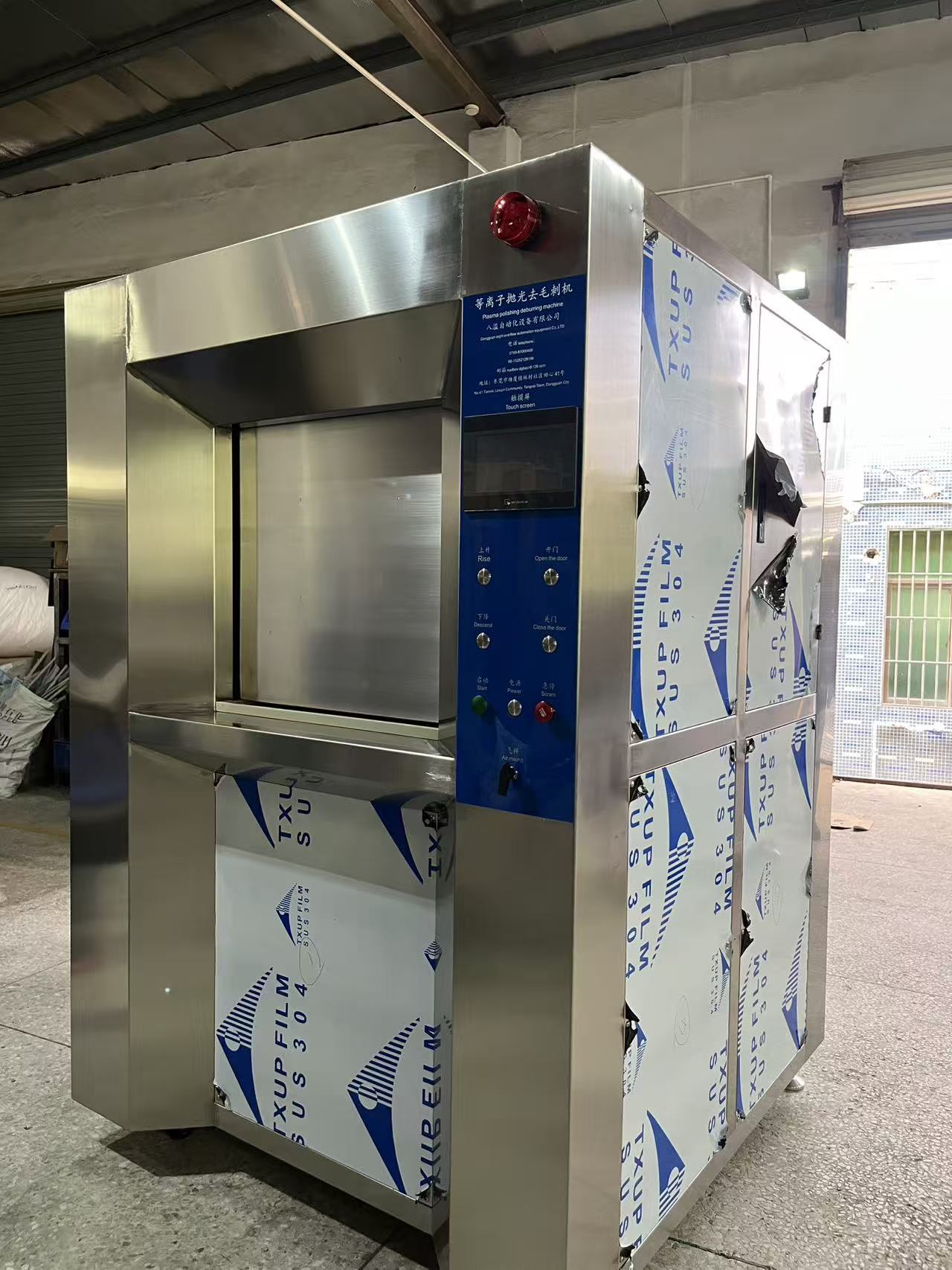
Plasma polishing removes material from the surface to deliver three outcomes: burr removal, edge rounding and smoothing toward a polished finish. In BAYI's range this capability is positioned as precision deburring and ultra-fine polishing. The BY-1000A fully automatic plasma polishing machine and the BY-500A jewelry plasma polishing machine both state a deburring rate of 99.9% or higher, list high compatibility and no damage to the original part among their advantages, are described as energy saving and environmental protection, and operate with a fully automatic control system.
Materials covered by named models include stainless steel (BY-1000A), titanium (BY-800A titanium plasma polishing machine) and precious metals and gold jewelry (BY-500A). The BY-100A machine's inner groove main body is built in 316L stainless steel. Listed applicable industries across these models include medical devices, aerospace, 3C electronics and precision hardware, automotive and new energy, semiconductor, and 3D printing.
Best fit: parts where the requirement is geometric - burrs at machined edges, corners that must be radiused, support marks on 3D printed parts, or a matte surface that has to reach a polish.
Ultrasonic cleaning: contaminant removal
Ultrasonic cleaning transmits high-frequency sound through a liquid bath, generating cavitation - the formation and collapse of microscopic bubbles - that lifts contaminants from surfaces and from recesses that brushing cannot reach. Its function is cleaning, not shaping: it does not cut an edge, does not remove a burr, and is not the process that sets the final roughness or gloss of the metal.
Best fit: parts whose geometry is already correct but whose surface carries oil, chips, polishing residue or dust - typically as the step before inspection, assembly, coating, packaging or sterilization. BAYI supplies ultrasonic cleaning equipment within the same surface finishing portfolio as its plasma polishing and deburring machines, so both steps of the sequence can be specified from one supplier.
Where the two overlap
Three overlap zones create most of the confusion:
- The same cell. Both are wet processes installed in the post-processing area, so they appear in the same quotation.
- The same geometry challenge. Both are selected precisely because parts have internal channels, blind holes or hard-to-reach features.
- The same sequence. In many lines the two are consecutive rather than alternative steps: plasma polish or deburr first to correct geometry and finish, then ultrasonic clean to remove process residues and handling contamination before inspection or packing.
The third point is the one most often left out of an evaluation. A buyer who compares the two as substitutes will under-specify whichever process is dropped from the line - and will usually discover the gap only after installation.
The BAYI Equipment Portfolio Behind the Decision
Dongguan Bayi Automation Equipment Co., Ltd. is a manufacturer based in Dongguan, Guangdong, China, established in June 2017. Its core technical members have 17 years of experience in the research, development, design and manufacturing of plasma polishing and deburring equipment. The company operates an 800 m2 factory with 50 employees and a three-engineer R&D team, serves main markets in North America, Europe and Southeast Asia, and exports approximately 10% of its output. Its registered address is No. 41 Tianxin, Lincun Community, Tangxia Town, Dongguan, Guangdong, China.
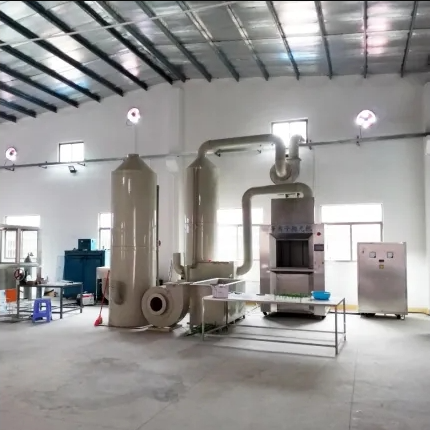
Three product lines are relevant to this comparison:
- Plasma polishing machines - standard models 100A, 300A, 500A and 800A, with non-standard models from 1000A to 2500A.
- Plasma deburring machines - including the deburring and polishing integrated machine.
- Ultrasonic cleaning machines - supplied alongside polishing machines, deburring machines and jewelry polishing machines.
Customization. BAYI designs special plasma polishing and deburring equipment according to the customer's product size, shape and yield requirements. Documented special configurations include:
- Tape type plasma polishing equipment - automatically collects square material and polishes a whole roll without cutting.
- Long tube plasma polishing equipment - for pipes of more than 2 meters in various types, in continuous production.
- Chain-type plasma polishing equipment - automatically collects square material into a roll for polishing.
Commercial and delivery facts worth recording at the evaluation stage: MOQ 1 unit, lead time 30-45 days, monthly capacity of 70,000-110,000 medium parts, 100% test quality control, and after-sales support delivered remotely, with video technical support outside the warranty period and a one-year warranty on core components.
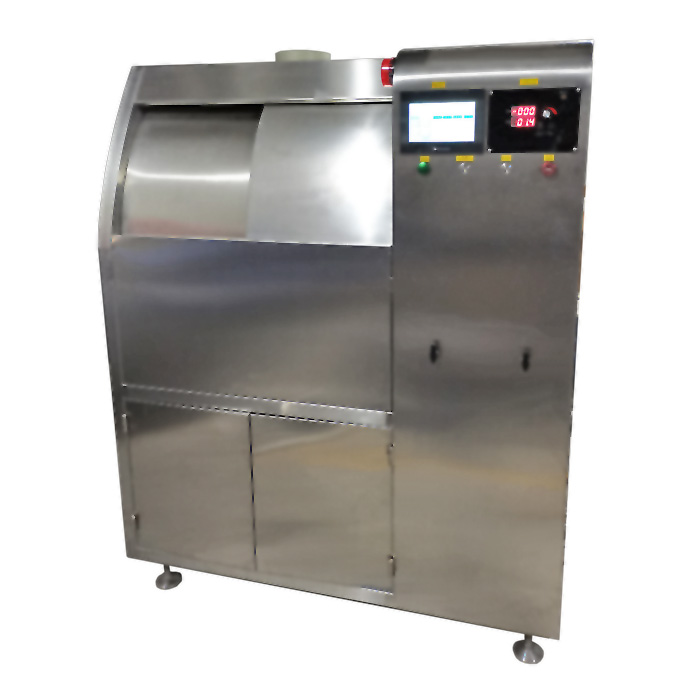
Reference specification: BY-100A
| Parameter | BY-100A |
|---|---|
| Power | 30 KW |
| Input power supply | Three-phase five-wire 380V |
| Max output current | 100A |
| Gas source | 0.5-0.8 MPa |
| Machine size | 1150 x 1200 x 1800 mm |
| Weight | 150 kg |
| Power cabinet size / weight | 850 x 600 x 1500 mm / 100 kg |
| Available hanger space | 360 x 260 x 200 mm |
| Inner groove main body material | 316L stainless steel |
| Listed applicable industries | Medical care, confidential processing, 3D printed dentures, precious metal and gold jewelry |
Comparison Table: Plasma Polishing vs. Ultrasonic Cleaning
| Decision factor | Plasma polishing / plasma deburring | Ultrasonic cleaning |
|---|---|---|
| Primary function | Material removal - burr removal, edge rounding, surface smoothing | Contaminant removal - oil, chips, polishing residue, dust |
| Decision trigger | A geometric defect: burr, sharp edge, rough or matte surface | A foreign substance on an otherwise correct surface |
| Effect on burrs | Removes burrs; the BAYI BY-1000A and BY-500A models state a deburring rate of 99.9% or higher | Not designed to remove burrs |
| Effect on roughness and gloss | Achieved through precision deburring and ultra-fine polishing | Does not set the final roughness or gloss |
| Process environment | Wet process; parts are held in the machine's working and hanger envelope (BY-100A: 360 x 260 x 200 mm) | Wet process; parts are immersed in a liquid bath |
| Materials covered by named BAYI models | Stainless steel (BY-1000A), titanium (BY-800A), precious metals and gold jewelry (BY-500A), 316L stainless steel inner groove (BY-100A) | Supplied within BAYI's surface finishing portfolio; suitability is confirmed against the specific part and process requirement |
| Customization route | Designed around part size, shape and yield; non-standard 1000-2500A; tape, long-tube (over 2 m) and chain-type configurations | Configured on the same size, shape and yield basis as part of the overall finishing line layout |
| Typical position in the line | After machining, forming or 3D printing; before final cleaning | After polishing or deburring; before inspection, assembly, coating or packing |
The table describes sequence logic rather than a ranking. Neither column is universally better; they remove different things, and the correct specification is the one that matches the defect on the drawing.
Step-by-Step: How to Decide for Your Parts
Step 1 - Name the defect from the drawing and the inspection report. If the reject reason reads burr, sharp edge or rough surface, the requirement is a material-removal process. If it reads oil, residue, particles or contamination, the requirement is a cleaning process. If both appear, plan for both.
Step 2 - Check the part against the machine envelope. Plasma polishing holds parts in a defined working space: the BY-100A offers 360 x 260 x 200 mm of available hanger space. Parts beyond that envelope move to a larger standard model (300A, 500A, 800A) or to a non-standard 1000-2500A build. Parts in continuous or coiled form may point to a special configuration - tape type for whole-roll polishing without cutting, long-tube type for pipes over 2 meters, or chain-type for automatic collection into a roll. For ultrasonic cleaning, the equivalent check is whether the bath and basket accommodate the part and allow the cleaning liquid to reach the geometry that carries the contamination.
Step 3 - Set the finish requirement in measurable terms. Write down whether the part needs edge rounding, a specific roughness target, a decorative gloss, or simply a clean, residue-free surface. A gloss or edge-radius requirement cannot be met by cleaning alone; a residue requirement cannot be met by polishing alone.
Step 4 - Map the material and what happens downstream. Stainless steel, titanium and precious metals are all covered by named BAYI models, but the downstream process matters too: parts that will be welded, coated, sterilized or assembled need to be free of residues at the point of handover, which is a cleaning requirement regardless of how good the polish is.
Step 5 - Validate on samples, then lock capacity, lead time and customization. Sample validation is where the sequence is confirmed rather than assumed. Once the process is fixed, check throughput against the stated monthly capacity of 70,000-110,000 medium parts, plan around a 30-45 day lead time, and confirm any customization of equipment to part size, shape and yield before the purchase order is issued.
Decision shortcut. Burrs or edge radius on the drawing: plasma polishing / plasma deburring. Only oil, chips or residue present: ultrasonic cleaning. Both defects present: run them in sequence, plasma first, cleaning after.
Use Cases: Where Each Method Carries the Step
Medical devices and dental parts. The BY-100A lists medical care, confidential processing and 3D printed dentures among its applicable industries; the BY-1000A lists medical devices; and the plasma deburring machine lists medical apparatus and instruments. In these applications the driver is usually edge quality and surface consistency rather than cleaning alone, because a residual burr is a functional and regulatory concern, not a cosmetic one. Industry-wide, the medical and pharmaceutical sector accounted for a 34.2% share of the electropolishing services market (Dataintelo), which reflects how much high-precision finishing demand originates in this field.
Jewelry and precious metals. The BY-500A jewelry plasma polishing machine is specified for precision deburring and ultra-fine polishing with a deburring rate of 99.9% or higher, and lists high compatibility and no damage to the original part as advantages. Where the part is precious metal, the value of a controlled, non-abrasive removal process is measured in material preservation as well as appearance.
3D printing post-processing. 3D printing appears among the listed applicable industries for the BY-1000A and for the plasma deburring machine, and 3D printed dentures specifically for the BY-100A. Printed parts typically arrive with support marks, stair-stepping and a matte surface - all geometric or surface conditions that require material removal before any cleaning step adds value.
Electronics and precision hardware. 3C electronics and precision hardware appear among the listed industries for the BY-1000A. A documented BAYI project for Hebei Hengxin, in China, involved the installation of 2 units for the processing of electronic accessories; customer feedback indicates stable operation over a 7-year period, and guidance on installation is recorded as a case highlight.
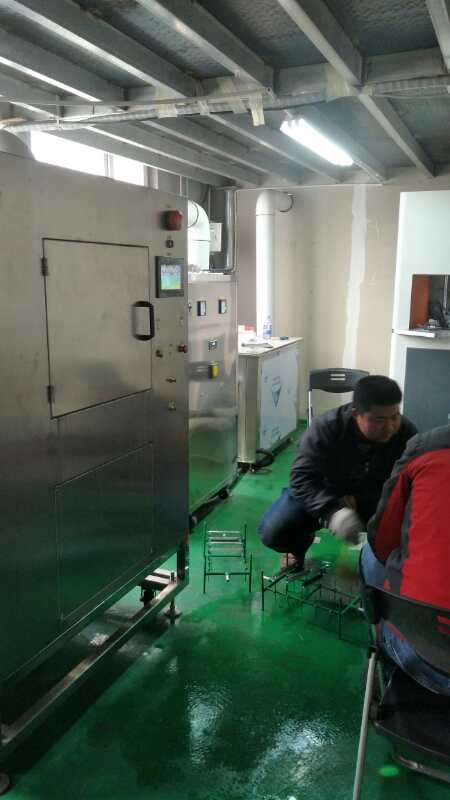
Where ultrasonic cleaning carries the step alone. When the geometry is already correct and the only requirement is a residue-free surface before assembly, coating, packaging or sterilization, cleaning is the whole specification. In that case the decision is about bath configuration, part handling and the cleaning sequence - not about polishing capability.
Frequently Asked Questions
1. Are BAYI's plasma polishing machines CE certified, and which standards apply?
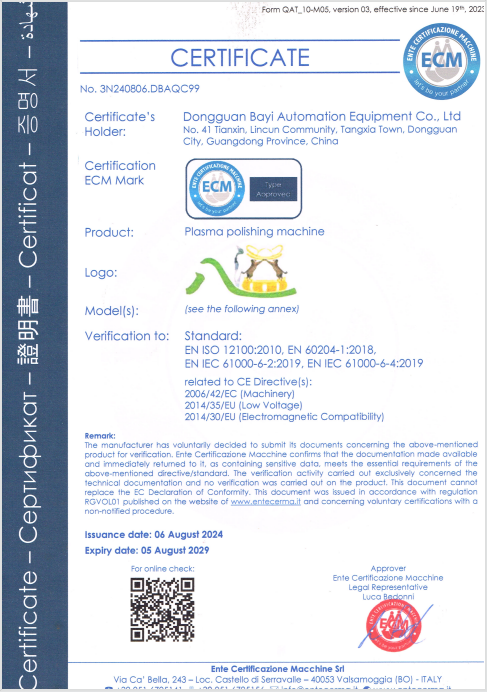
Yes. BAYI holds CE certification No. 3N240806.DBAQC99, issued by Ente Certificazione Macchine on 2024-08-06 and valid through 2029-08-05. The certificate relates to CE Directives 2006/42/EC (Machinery), 2014/35/EU (Low Voltage) and 2014/30/EU (Electromagnetic Compatibility), and to the standards EN ISO 12100:2010, EN 60204-1:2018, EN IEC 61000-6-2:2019 and EN IEC 61000-6-4:2019. The certified product is the plasma polishing machine, covering models including BY-100A, BY-500A, BY-800A and BY-1000A, together with the BY plasma deburring machine. More broadly, industry guidance lists ISO 9001 (quality), CE (safety) and RoHS (environmental) as market-access requirements for plasma treatment equipment.
2. Can a plasma polishing machine handle both deburring and polishing, and when is ultrasonic cleaning still needed?
In BAYI's range, the deburring and polishing integrated machine is built for both functions, and the BY-1000A and BY-500A models state precision deburring and ultra-fine polishing with a deburring rate of 99.9% or higher. Ultrasonic cleaning remains necessary when the requirement includes removing oil, chips, polishing residue or handling contamination - for example before assembly, coating, packaging or sterilization. If the drawing specifies only edge condition and finish, plasma processing may cover the requirement on its own; if it also specifies cleanliness, plan the two steps in sequence and validate the combination on sample parts.
3. How should we compare the cost of a plasma polishing machine with an ultrasonic cleaning machine?
It is rarely a straight machine-to-machine price check, because the two devices do different work. On the plasma side, the main cost drivers are the model class (standard 100A-800A versus non-standard 1000-2500A), the working and hanger envelope, the level of automation (the BY-1000A uses a fully automatic control system), and any special configuration such as tape, long-tube or chain type. On the cleaning side, cost is driven by bath size, part handling and how tightly the cleanliness requirement is defined. BAYI's stated minimum order quantity is 1 unit, which allows a single-machine trial before scaling. The more useful calculation is the total cost of the finishing step - labor, consumables, floor space, rework rate and whether the line needs one machine or two.
4. Can we validate the process on our own parts before ordering?
Yes - sample validation is the appropriate way to confirm the choice before committing. BAYI designs equipment around the customer's product size, shape and yield, and a documented case shows the outcome: a project for Hebei Hengxin in China involved the installation of 2 units for electronic accessories processing, with customer feedback indicating stable operation over a 7-year period and installation guidance recorded as a case highlight.
5. What lead time and capacity should we plan for?
BAYI states a lead time of 30-45 days and a monthly capacity of 70,000-110,000 medium parts, with 100% test quality control on shipped equipment. Warranty coverage runs for one year on core components, with remote support during the warranty period and video technical support outside it. If your production plan depends on a customized configuration - for example a long-tube line for pipes over 2 meters or a tape-type system for coiled material - confirm the specification before the order so the lead time covers both engineering and build. To move forward, request a sample evaluation or a quotation against your part drawings, or download the BAYI product brochure at https://cdn.socialarks.com/sbsp/24726/0/2026/0407/69d4b97a7df44.pdf for the full equipment range.
Conclusion: Choose by Defect, Then Specify the Sequence
Plasma polishing and ultrasonic cleaning solve different problems, and the fastest way through the evaluation is to stop treating them as alternatives. Look at the reject reason: burrs, sharp edges and roughness belong to plasma polishing and plasma deburring; oil, chips and residues belong to ultrasonic cleaning. When both appear on the same part - which is normal in machining, 3D printing and electronics work - the two run in sequence, plasma first.
BAYI supports that decision with a portfolio that spans both steps: plasma polishing machines in standard 100A-800A and non-standard 1000-2500A models, plasma deburring machines and ultrasonic cleaning equipment, all designed around part size, shape and yield, backed by 17 years of core-team experience in plasma polishing and deburring equipment, CE certification valid through 2029, a 30-45 day lead time and a minimum order quantity of 1 unit.
Next step: test your part, not a brochure
Send part drawings, material and the defect you need to remove, and BAYI will confirm whether the requirement is a material-removal step, a cleaning step, or both.
Email: tanzhengao@bayiauto.cn | Tel: +86 152 8212 9198 | WhatsApp: +86 185 6593 9648
Website: metalsurfacefinishingequipment.com
Download the BAYI equipment brochure: BAYI product brochure (PDF)
Have Questions or Need More Details?
Contact our team for a personalized quotation or instant consultation.
Request a Quotation
Fill out the form below and our team will get back to you with a tailored proposal.
WhatsApp Direct Chat
Prefer to chat in real-time? Message us on WhatsApp for instant assistance & quick answers.
- Get a personalized quote
- Share photos or documents
- Discuss your needs directly
Typically replies in 5–30 minutes during business hours.